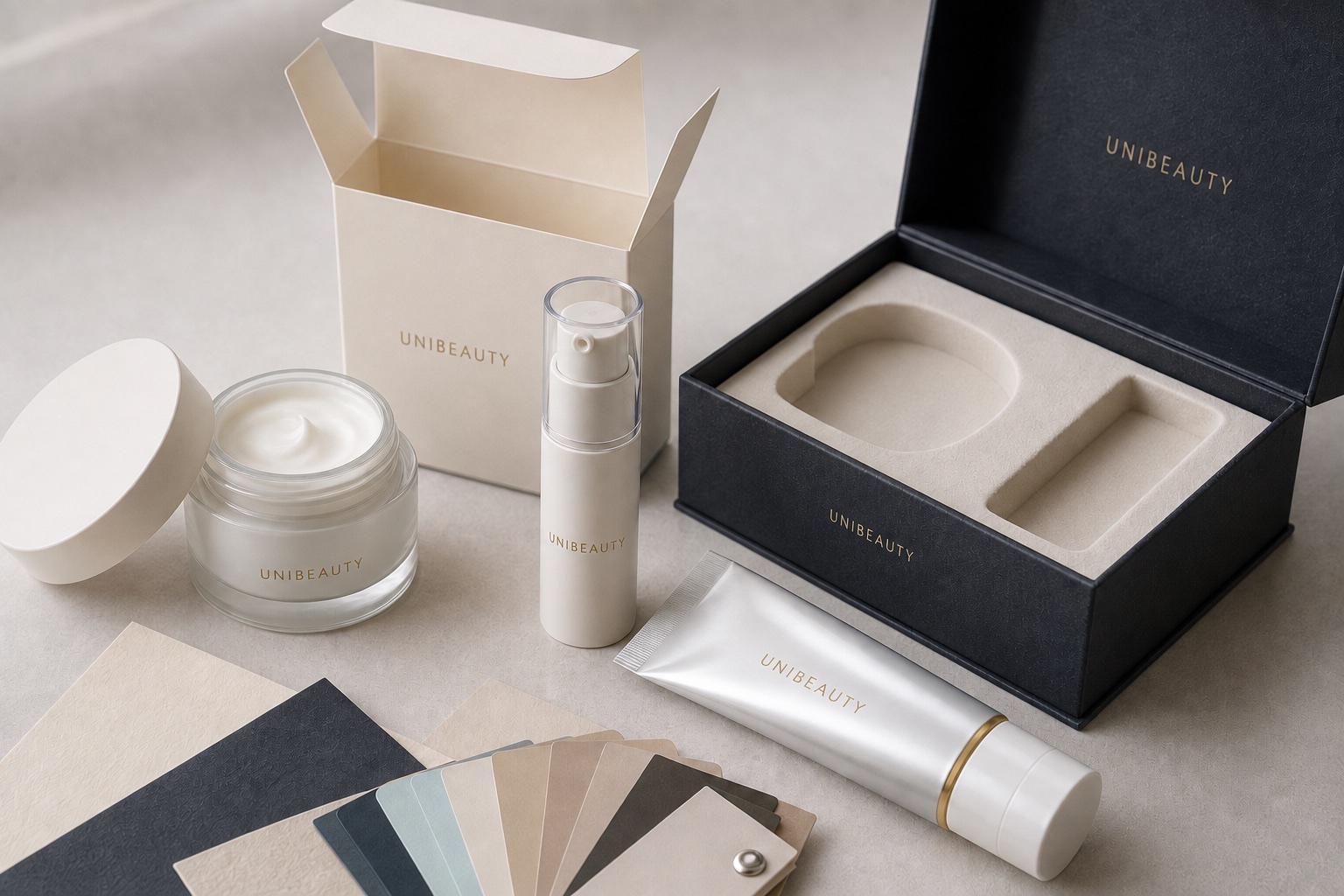
Containers & Formats
Jars, bottles, pumps, sprays, tubes, aluminum tubes, compacts and selected custom shapes or sizes.
Bring a market reference, physical sample, drawing or original idea. UniBeauty coordinates the path from container and decoration to outer box, set assembly and delivery preparation.
High-fidelity packaging development begins after the material, process, tooling, order volume, product compatibility, testing and intellectual-property boundaries are reviewed. A reference is the starting point—not an unconditional promise of an exact copy.
A premium presentation can be achieved through different combinations of container, decoration and outer packaging. Compare glass, aluminum-tube and plastic options for appearance, hand feel, dispensing, formula compatibility, packed weight, order quantity and complete cost. A heavier container or a new mold is an investment choice, not a substitute for a well-matched product. We put those choices within the same target price and launch plan.
Jars, bottles, pumps, sprays, tubes, aluminum tubes, compacts and selected custom shapes or sizes.
Clear or opaque plastics, frosted or clear glass, aluminum and selected mixed-material structures.
Foil stamping, screen printing, pad printing, UV printing and other project-matched decoration routes.
For a collection, define which products sell individually and which belong in a set. Compare the target set price with the combined cost of products, outer box, inserts, decoration and assembly. Shared box sizes or components are considered where they fit the products and purchasing volumes; each configuration still needs protection, presentation and handling checks.
Magnetic rigid boxes, drawer boxes, lid-and-base structures and travel-case presentations.
Folding cartons, sleeves, labels, inserts and structures selected around the product and channel.
Makeup, skincare, lashes, tools, makeup bags and selected accessories planned as one program.
Build a component list for each finished set: product versions and quantities, containers, cartons, inserts, accessories and labels. Link each item to its approved sample and readiness date. Confirm dimensions and fit before locking the insert, and assemble a complete sample to review appearance, handling and packing. A missing component can hold up a kit, so separate essential kit dependencies from products that have an independent launch route.
External packaging example — one tray, two set configurations
Wynalda’s published Dr. Squatch discovery-pack project used a common molded-pulp tray with different paperboard masks for three- and five-bottle versions. Its team iterated fit samples before a transport study. This illustrates a concrete question for a multi-SKU brief: can a shared structural element support more than one set while preserving product fit and presentation? Read Wynalda’s project account.
This is Wynalda’s project, used as an industry reference. For UniBeauty projects, structural choices are evaluated against the selected products, quantity plan, testing and complete quotation.
Confirm the product format, fill size, channel, target market, quantity and launch purpose.
Separate visual targets from protected brand elements, patented structures and unavailable processes.
Review component, substrate, dimensions, closure, insert, decoration and compatibility needs.
Control sample version, color, logo application, files and acceptance criteria.
Lock quantities, tooling, tests, tolerances, packing method, open conditions and timing.
Retain approved dimensions, colors, materials, decoration, artwork and packing details for future production. Review demand separately for full sets and individual products, including component balances and planned design changes, before setting repeat quantities.
Which ODM cosmetic container options can be reviewed? The shortlist is built from the product and use case rather than from appearance alone. Possible directions include jars, bottles, pumps, sprays, tubes, compacts, droppers, treatment pumps, airless formats and selected custom structures. The exact component, material, closure or dispensing system, decoration and carton must still be confirmed against the formula or product, fill size, quantity per version, target cost, destination market and compatibility plan.
What should an OEM freeze-dried cosmetic single-dose pellet brief include? Treat it as a complete product system rather than an empty-container request. Define the formula or dry product, dose, intended use, freeze-drying route, reconstitution or activator step, primary pack and closure, moisture and oxygen protection needs, units per retail pack, instructions, destination market, annual quantity and required stability, microbiological, compatibility or performance evidence. UniBeauty must first confirm the appropriate qualified manufacturing and packaging route before availability, samples, MOQ, timing or quotation can be stated.
Can a standard cosmetic container be assumed suitable for a freeze-dried single dose? No. The dry unit, activator where applicable, sealing and barrier system, opening method, dose delivery and final outer pack need to work together. Use the formulation-development brief and packaging documentation checklist to organize the technical and evidence questions before selecting a component.
Materials, tooling, minimum quantities, compatibility, testing, timing, intellectual-property review and final production feasibility remain project-specific and must be confirmed before order approval.
UniBeauty coordinates containers, decoration, cartons, gift sets and kitting across makeup, skincare and beauty tools. We align brand colors and presentation across the selected product range.
The approved packaging specification connects component dimensions, material and color references, decoration, artwork versions, retail cartons, inserts and set assembly. We also provide product images, videos, product descriptions and selling-point or channel-display materials around the actual product and brand brief. Confirm the required views, languages, file formats and delivery dates so the materials are ready for the customer’s launch.
To compare packaging routes, provide the product format and fill volume, preferred material or reference pack, decoration and logo direction, retail carton or kit requirements, destination market and estimated quantity by version.
Final materials, formula, compatibility, testing, documentation, quantities, timing and market requirements are confirmed for the specific project.
UniBeauty can review the packaging layers, open decisions and next sampling step as one coordinated program.
Packaging decision priorities
Select airless, refillable and serum packaging through compatibility—not appearance alone
Custom cosmetic packaging should be evaluated against formula behavior, dosage, fill process, transport, decoration and target-market requirements. UniBeauty coordinates packaging choices with the wider product-development brief.
Airless cosmetic packaging
Review dosage, viscosity, evacuation target, pump behavior and component compatibility for an airless pack direction.
Serum bottles & pumps
Match dropper, treatment pump or airless formats to formula, dose, filling and consumer-use requirements.
Refillable packaging concepts
Evaluate refill mechanism, material mix, decoration, assembly and user instructions before making sustainability claims.
Decoration & component coordination
Align color, finish, print area, applicator and secondary packaging with the brand system and production tolerances.
Related capabilities: formula development · private label skincare · private label makeup · OEM/ODM coordination · review a packaging brief