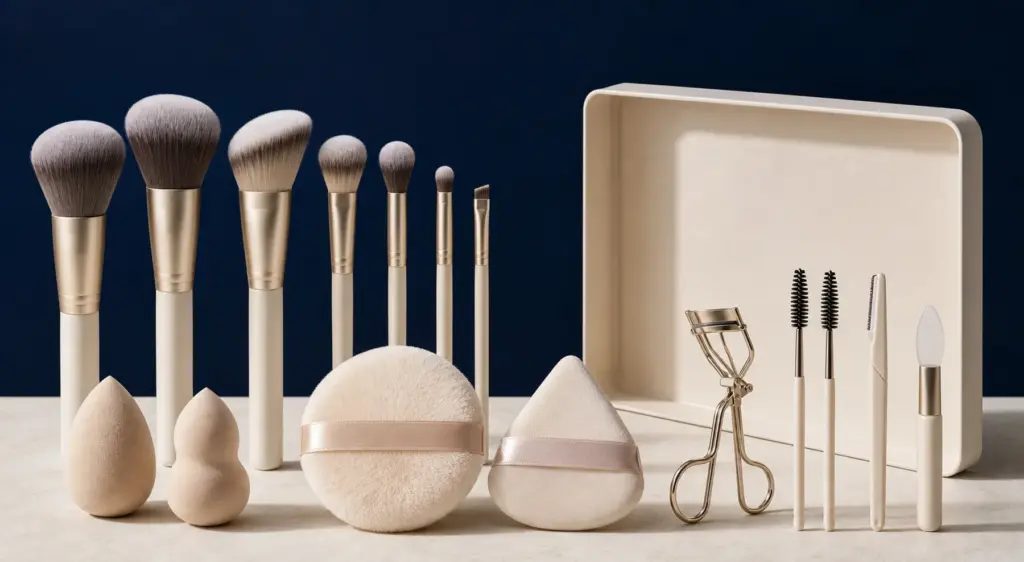
The price and minimum order quantity for a custom beauty tool are not determined by the product name alone. A makeup brush, sponge, powder puff, lash tool or accessory set can follow several sourcing routes, and each route creates a different combination of material, tooling, decoration, packaging, sampling and assembly requirements.
This guide helps beauty brands and sourcing teams prepare a quote brief that suppliers can review accurately. It does not publish a universal price or MOQ because those figures are project-specific. Instead, it shows which decisions change cost, where MOQ constraints normally originate and how to compare supplier quotations on the same basis.
Planning a beauty tool project? Send your project brief for a project-specific cost and MOQ review.
Start With the Sourcing Route
The first cost decision is not the logo. It is the development route.
1. Existing product with custom packaging
This route uses an existing tool construction and focuses customization on packaging, presentation and selected decoration. It can reduce development work when the existing product already meets the required function, dimensions and material direction.
It is most suitable when the buyer values speed and a lower level of structural customization. The product still needs to be evaluated for performance, finish, compatibility with the intended formula or use case, and consistency with the target market.
2. Existing construction with product customization
This route starts with an established construction but changes elements such as color, material grade, handle finish, sponge density, puff ribbon, printing, logo placement or set composition.
The final MOQ may be controlled by more than one component. A product-level order quantity can be affected by the color batch, decoration process, component supplier, packaging print run or assembly plan.
3. New structure or tooling
A new shape, mould, applicator structure, handle geometry, case or accessory mechanism introduces development and tooling decisions. The supplier needs clear dimensions, functional expectations, material direction, tolerance requirements and ownership terms before a reliable quotation is possible.
This route should be chosen because the new structure creates a meaningful commercial or functional difference—not simply because “fully custom” sounds more distinctive.
For a wider view of available formats, visit Custom Beauty Tools Manufacturer.
What Changes the Unit Cost?
| Cost driver | Questions a buyer should answer | Why it matters |
|---|---|---|
| Product construction | Is the item standard, modified or newly tooled? | New structures add engineering, sampling and tooling work. |
| Material | What fibre, foam, fabric, metal, plastic, silicone or mixed material is required? | Material grade and processing route affect performance and cost. |
| Dimensions and density | What size, shape, weight, thickness, density or tolerance is needed? | Small dimensional changes can affect moulds, cutting, assembly and packing. |
| Color and surface finish | Is a stock color acceptable, or is custom matching required? | Custom color batches and finish standards can introduce separate minimums. |
| Logo method | Printing, foil, engraving, embossing, woven label or another method? | Decoration has setup, placement, durability and component constraints. |
| SKU count | How many colors, shapes, styles or sets are included? | Splitting volume across many SKUs can reduce efficiency and create separate minimums. |
| Packaging | Bulk pack, pouch, printed carton, tray, case, display or gift set? | Packaging often has its own MOQ, print setup and assembly requirements. |
| Quality and testing | Which performance, material or market requirements apply? | Testing and documentation should be defined before final quotation. |
| Order and delivery terms | What quantity, destination and commercial term should be quoted? | A unit price is not comparable unless the quote basis is the same. |
Where MOQ Constraints Usually Come From
A supplier may quote one project MOQ, but that figure is often built from several underlying constraints:
- the smallest efficient material or color batch;
- the minimum run for moulding, cutting, tufting or component production;
- the setup requirement for printing, foil, engraving or another decoration method;
- the printed packaging supplier’s minimum run;
- the number of SKUs sharing the total order quantity;
- the assembly and quality-control plan;
- the supplier’s ability to combine stock and custom components.
This is why a broad question such as “What is your MOQ for makeup sponges?” is not enough for an accurate comparison. A better brief states the sponge type, dimensions, density or softness direction, color count, logo method, packaging, SKU count and expected quantity.
For a general framework across beauty categories, see beauty product MOQ planning.
Product-Specific Cost Questions
Custom makeup brushes
For custom makeup brushes, define the brush count, intended use, fibre direction, ferrule material and finish, handle material, shape, decoration and set packaging. A ten-piece set should not be compared with another ten-piece set until the brush functions and component specifications are aligned.
Makeup sponges
For private label makeup sponges, provide the shape, dimensions, density or softness direction, surface requirement, color, logo method and individual or set packaging. The intended use with liquid, cream or powder products should also be clear.
Powder puffs
For custom powder puffs, specify the face material, filling or internal structure, shape, thickness, ribbon or strap, edge finish, logo method and packaging. Compatibility with the intended powder format and compact dimensions can be a critical design constraint.
Lash and precision tools
For lash applicators, tweezers, curlers, brow tools and precision accessories, define the material, tip or contact geometry, finish, grip, functional tolerance and retail presentation. If the project is part of a lash kit, review it together with the private label lashes and packaging plan.
Multi-item kits
For brush sets, sponge sets, lash kits or mixed accessory collections, the buyer should identify which components are stock, modified or newly developed. The set MOQ may be controlled by the least flexible component or by the printed packaging—not by the easiest item in the kit.
The Minimum Brief Needed for a Useful Quote
Prepare the following information before asking suppliers for price:
- Product type and intended use.
- Reference image, drawing or existing sample where available.
- Required dimensions, material and performance direction.
- Number of SKUs, colors, shapes or set combinations.
- Logo and decoration method.
- Packaging structure and presentation.
- Estimated order quantity by SKU and in total.
- Target market and any known testing or documentation requirements.
- Target timeline.
- Commercial basis for comparison, including delivery destination and requested trade term.
When some specifications are still open, mark them as decisions that need supplier input. An incomplete but honest brief is more useful than a fixed specification based on assumptions.
Sample Stages Should Match the Development Route
The sample plan should answer different questions at different stages:
- Evaluation sample: Does an existing construction meet the basic function and quality direction?
- Customized sample: Are color, material, decoration and packaging moving toward the approved brief?
- Pre-production or approval sample: Does the final configuration represent the version that should be used for bulk production and inspection?
Not every project uses the same number of sample stages. New tooling, complex sets, strict color matching or coordinated packaging may require more development work than a standard product with a printed carton.
Record each approved decision so later quotations and samples are compared against the same specification.
How to Compare Supplier Quotations
Do not compare unit prices until the scope is normalized. Check whether each quote includes the same:
- product construction and material;
- dimensions, tolerance and quality level;
- logo or decoration method;
- packaging components and assembly;
- sample, mould or tooling charges;
- testing or documentation scope;
- inspection arrangement;
- quantity by SKU;
- trade term and destination assumptions;
- validity period and change conditions.
A lower unit price may reflect a different material, simplified decoration, excluded packaging, a higher order quantity or a different delivery basis. The purpose of quote normalization is to identify those differences before selecting a supplier.
Questions Buyers Commonly Ask
Can one MOQ apply to every beauty tool?
No. Brushes, sponges, puffs, lash tools, components and printed packaging can follow different production routes. The project MOQ should be confirmed after the complete bill of materials and SKU split are understood.
Does a custom logo always require a new mould?
No. Printing, foil, engraving, embossing, woven labels and other decoration methods may use an existing construction, depending on the material and design. A structural logo feature or newly shaped component may require tooling.
Can different tools be combined into one set?
Often, yes, but the set plan must account for each component’s availability, customization minimum, packaging fit and assembly requirement. The least flexible component can determine the practical set quantity.
Why does packaging affect the MOQ?
Printed cartons, inserts, trays, pouches, cases and displays have their own production and setup constraints. Packaging should be quoted together with the product when it is part of the retail presentation.
What should I send if my specification is not final?
Send the product category, intended use, reference direction, target market, estimated quantity, desired customization, packaging goal and timeline. UniBeauty can use those inputs to identify which decisions must be confirmed before a reliable quotation.
Request a Project-Specific Review
There is no responsible universal price or MOQ for “custom beauty accessories.” A useful answer depends on the product, material, dimensions, logo, packaging, SKU count, quantity, market requirements and delivery basis.
Send your project brief with the information you already have. UniBeauty can review the sourcing route, identify the main cost and MOQ drivers, and outline the next information needed for sampling or quotation.